
Nostos/Home
A Biblical Theology of Home

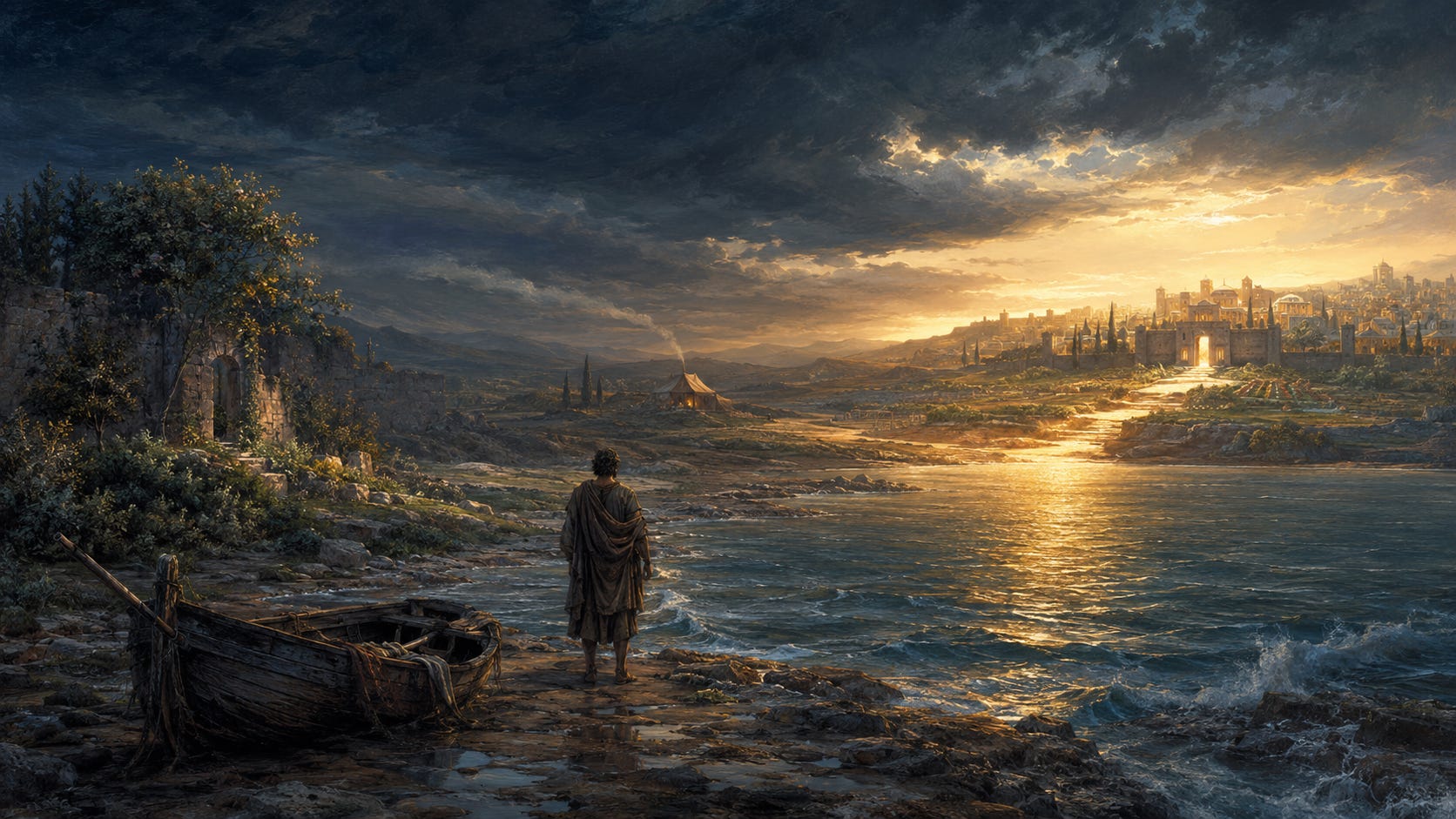
I went to see Christopher Nolan’s, The Odyssey. It was absolutely brilliant, three hours of wonder seen on a big screen in a reclined Luxe Ultra cinema seat with a bucket of sweet and salty popcorn and lashings of Pepsi Max. I know there is a culture war surrounding this film, but in truth haters are going to hate and iconoclasts will be left in the end with nothing but rubble as they are demolishers and not builders. They should just eat more of the lotus and chill out!
Reflecting on this cinematic experience it got me thinking about Home.
In 1688 a young Swiss medical student called Johannes Hofer needed a name for an illness spreading through mercenary regiments stationed far from the Alps. Men stopped eating. They stopped speaking. Some simply lay down and, as far as anyone could tell, died of missing home. Hofer reached into Greek and labelled the ailment ‘nostalgia’, fusing nostos, the journey home, with algos, pain. Nearly three millennia before the diagnosis had a name, Homer had already written the case study. Its title was none other than the Odyssey.
Odysseus spends ten years fighting at Troy and ten more trying to get back from it, which tells you something about ancient priorities, winning wars was seemingly the easier part. The whole poem of The Odyssey is nostos literature. An epic built entirely around the ache to return. Along the way there are sirens, a cyclops, a sorceress who turns his men into pigs, a trip to the underworld, and enough shipwrecks to rival the apostle Paul. But strip away the monsters and what remains is a man who wants his bed, his wife, his dog, and his orchard, roughly in that order of urgency if not affection.
Penelope the stricken queen does all she can to avoid remarriage, weaving a shroud by day and unpicking it by night. Penelope is home in Ithaca but without Odysseus home isn’t home. Home in the Odyssey is not a minor thread, it is the entire plot.
Homer understood something true and rather terrible about being human. We are creatures inflicted by a congenital condition who can be homesick even while standing in our own kitchen. We can be imbibed with nostalgia for home as felt rather than home as named.
The Bible knew this long before Homer picked up his lyre, and it offers a diagnosis considerably more searching than a Swiss doctor’s coinage. According to Scripture, the ache is not primarily geographical. You can stand in the house you grew up in and still feel the cold draught of exile, because the home we are actually homesick for was never simply a postcode. It was a garden, and a Person, and we have not stopped missing either since we left.
The Garden We Lost
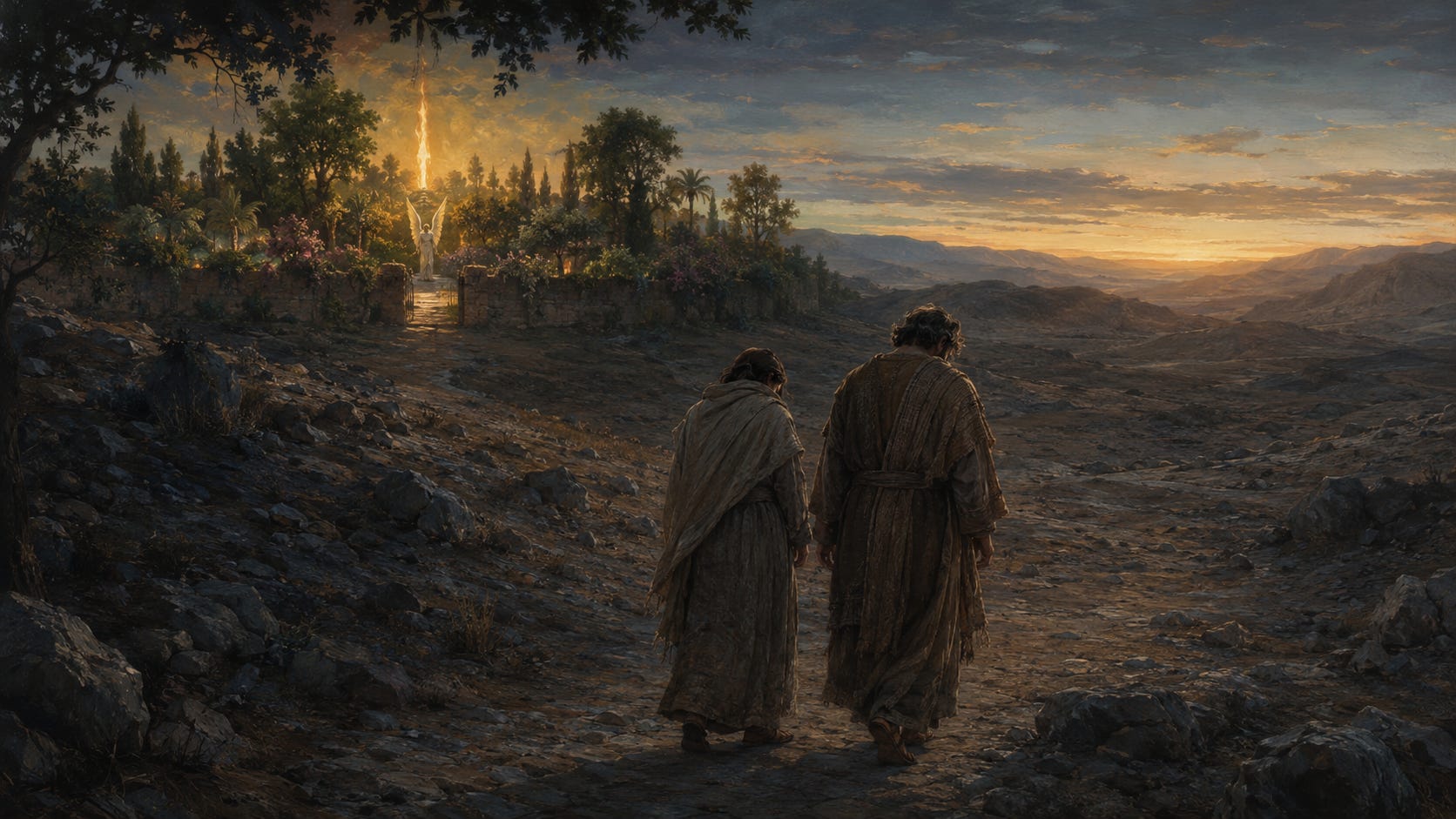
Genesis begins with real estate. God plants a garden and puts the man in it, and the placing matters as much as the planting. Eden is not wilderness that Adam happens to wander into and admire. It is a temple garden, a sanctuary built by God for the specific purpose of dwelling with His image bearers, and the text says as much when it describes God walking there in the cool of the day, as though the whole arrangement were domestic rather than merely religious.
Adam is not a tenant. He is a son, given work to do, a wife to love, and food that requires no toil to enjoy. This is home in its fullest sense, place, provision, purpose, and above all presence, four things bolted together so tightly that Scripture never really separates them again for the rest of the story.
Then comes the eviction. Notice how quickly, and how literally, the fall becomes a housing crisis. Adam and Eve are not merely disciplined. They are exiled, driven out, and cherubim with a flaming sword are stationed at the entrance for the express purpose of keeping them from getting back in.
Cain compounds the pattern a chapter later, murdering his brother and becoming, in his own despairing words, a restless wanderer on the earth. By Genesis 11 the entire human race is building a tower in an attempt to manufacture a home and a name for itself without reference to God, and God responds by scattering them further still. Homelessness, in the biblical account, is not one theme among many, it is perhaps the whole plot. It is the human condition after Genesis 3, the gouge underneath every other wound, and the rest of the Bible can fairly be read as God’s long campaign to bring his exiled children home.
Tents and a Promised Address
Abraham is where the campaign becomes personal. God calls him out of Ur, a city with walls and a name and presumably decent plumbing by ancient standards, and sends him to live in tents in a land he does not own, promised to descendants he does not yet have and barring a miracle cannot. It is a strange sort of homecoming that begins with further degrees of homelessness.
Hebrews later makes the logic explicit, Abraham lived as a stranger in the promised land, as in a foreign country, dwelling in tents, because he was looking forward to the city with foundations, whose architect and builder is God. Note the detail. Abraham was, in effect, camping on a promise, and the writer to the Hebrews is quite clear that this was not a failure of faith but the very substance of it. Home, for Abraham, was not yet a place. It was a word from God he had chosen to trust more than the ground under his feet or any roof over his head.
That pattern holds for more than four hundred years through Egyptian slavery, forty years of wilderness wandering, and a conquest narrative that only gets Israel as far as a land, not yet the presence that made Eden Eden in the first place. Which is exactly the gap the tabernacle was built to shrink.
A Tent Pitched Among Us
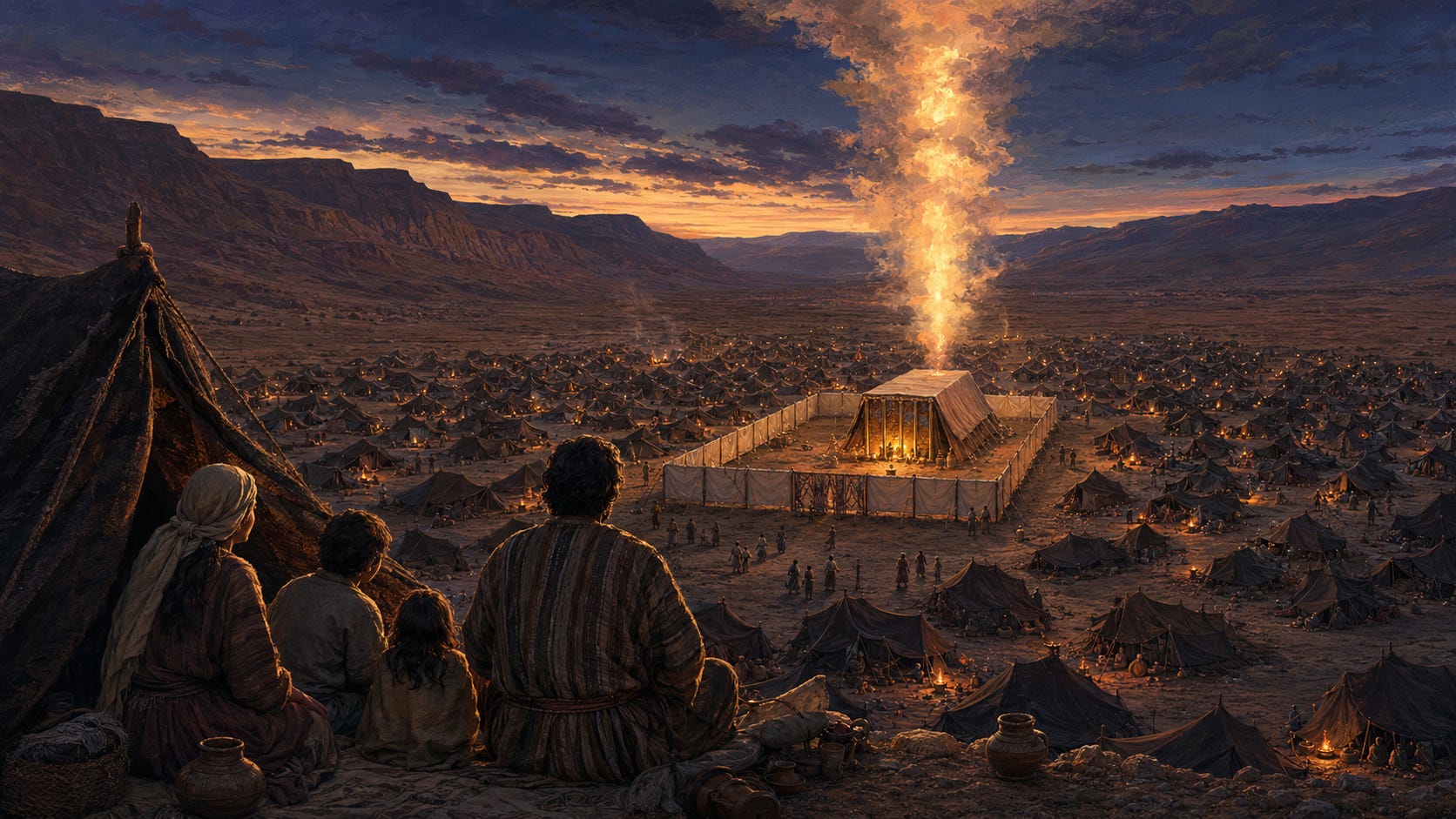
If Eden was God’s house and Israel’s exile was eviction from it, the tabernacle is God’s astonishing decision to move back into the neighbourhood amongst his people. It is worth sitting with how domestic the instructions in Exodus actually are, curtains, a table, a lamp, bread set out permanently as though for a household meal, and at the centre a mercy seat where God says he will meet with his people. This is not simply a venue for sacrifice. It is a portable Eden, cherubim woven into the curtains as a deliberate echo of the cherubim who barred re-entry into the original garden, except now they guard a way in rather than a way out. God pitches a tent in the middle of a wandering nation of tent dwellers and says, in effect, ‘I will be homeless with you until I can bring you properly home.’
The temple later makes the tabernacle temporally permanent, or tries to. Solomon’s prayer at its dedication is almost embarrassed by its own audacity, ‘will God indeed dwell on the earth, he asks, when heaven and the highest heaven cannot contain you?’ And yet God answers by filling the place with his glory anyway, because apparently the whole scandal of biblical religion is a God who insists on cramming himself into small spaces for the sake of the people he loves.
Which makes the exile, when it finally comes, so much worse than mere geography. Israel is cast out of the land in language the prophets recycle deliberately from Genesis 3, and by the waters of Babylon the psalmist can barely bring himself to sing. If I forget you, O Jerusalem, let my right hand forget its skill. That is not homesickness for a plot of land. It is homesickness for the presence the land was always meant to hold.
The Homeless King
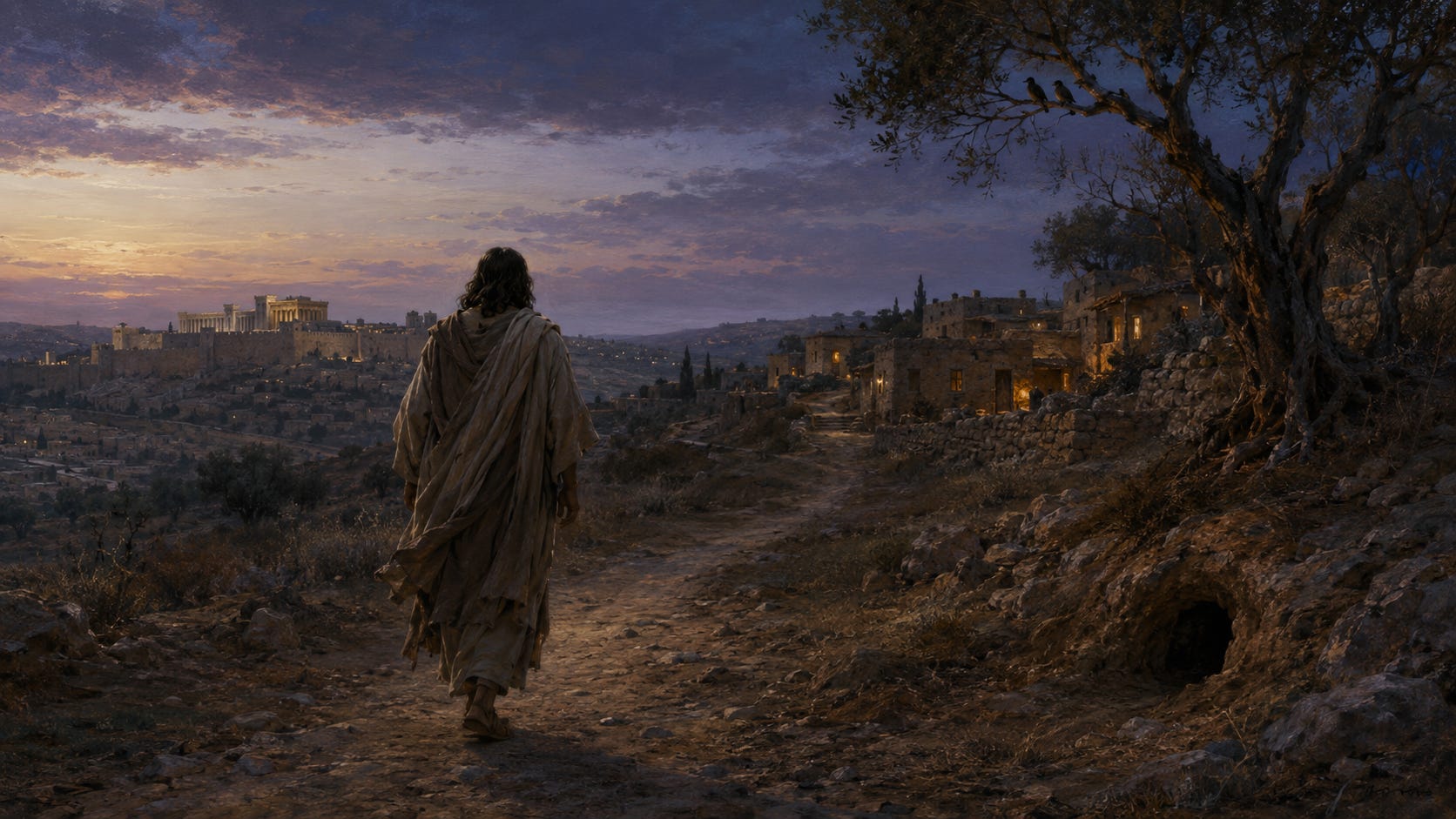
Into that long ache, John’s Gospel drops one sentence with the force of an earthquake. ‘The Word became flesh and ‘tabernacled’ among us, and we saw his glory.’ The verb belongs to the same family as the tent in the wilderness. Jesus is not merely visiting the human race. He is God pitching his tent among us again, permanently and in person this time, glory and all.
Yet the Gospels are startlingly frank about how little earthly home this brought him. As an infant he is a refugee in Egypt. As an adult he tells a would be follower, quite plainly, that foxes have holes and birds of the air have nests, but the Son of Man has nowhere to lay his head. The one person in history with every right to a home built the entire arc of his mission around having none, and it is worth pausing on that rather than rushing past it. When he stands in the temple and says destroy this temple and I will raise it again in three days, John tells us he was speaking of the temple of his body. Jesus does not simply visit God’s house. He becomes it. The dwelling place of God with humanity, promised since Eden and pictured in a tent of goat hair, turns out finally to be a person, crucified and risen, and every subsequent claim the New Testament makes about home hangs on that fact.
He goes further still. On the night before his death he tells his frightened disciples that in his Father’s house are many rooms, that he is going ahead of them to prepare a place, and that he will come again to take them to himself, so that where he is they may be also. It is, among other things, the most homesick promise in the New Testament, offered by the one man qualified to make it because he has walked every mile of exile without complaint on our behalf.
Odysseus needed twenty years, a war, a wooden horse, and a great deal of resourceful lying to get himself home. The gospel required none of that ingenuity from us, which is fortunate, since most of us possess roughly none of Odysseus’s cunning either. Christ did the travelling. We simply receive the address.
Citizens Now, Homesick Still
Ephesians takes that promise and applies it directly to anyone who trusts Christ. You are no longer strangers and aliens, Paul writes, but fellow citizens with the saints and members of the household of God, built on the foundation of the apostles and prophets, with Christ Jesus himself as the cornerstone. That word household is not decoration. It is the whole point. The church, for all its ordinary chairs and its instant coffee and its occasionally regrettable hymn choices, is the place where exiles get to practise being home again. It is scaffolding around a building not yet finished, family life rehearsed ahead of the wedding feast, a household whose only membership card is faith in the one who built the house.
This is why the New Testament can call believers sojourners and exiles in one breath, as Peter does, and citizens of heaven in the next, as Paul does to the Philippians, without any contradiction at all. We live now in the strange middle distance the theologians call already and not yet. The presence has come in Christ and dwells in us by his Spirit, which is genuinely, gloriously home. And the fullness of it has not yet arrived, which is why even settled, comfortable Christians can feel a persistent, low grade homesickness that no amount of good furniture or plush scatter cushions ever quite cures. That ache is not a spiritual malfunction. It is theologically correct. You are meant to feel it.
The City Whose Builder Is God

Which brings the whole arc to its resolution, in the closing chapters of Revelation, where John hears a voice from the throne say something that could serve as the last line of the Bible’s plot, behold, the dwelling place of God is with man. He will dwell with them, and they will be his people, and God himself will be with them as their God. Every tear wiped away. Death itself evicted this time, rather than us. A city descends, not a garden now but a garden grown into something greater, the tree of life planted at its centre and its leaves given for the healing of the nations, and no more sea, the ancient symbol of chaos and exile, because there is nothing left in the new creation to be homesick for.
It is Eden, but bigger. It is the tabernacle, but permanent. It is Ithaca, if Ithaca had never needed defending and Penelope had never needed to weave a single stitch of that shroud, because the enemy that made the whole journey necessary has finally, actually, been dealt with.
So if you are reading this somewhere that does not quite feel like home, in a body that aches in the wrong places or a season that has gone on rather longer than you would have chosen, take it as good theology rather than bad luck.
The homeless ache is old, older than Homer, and it was put there on purpose. The whole of Scripture is one long answer to it, and the answer, in the end, is not a place on a map at all. It is a person who tabernacled among us, was homeless so that we would not have to be, and has gone ahead to prepare the room.
Odysseus got home because he was clever and stubborn and extremely ‘lucky’. We get home because someone else already made the entire journey for us, and is coming back for the last leg with us in tow. That, and not cleverness, is rather the whole of the gospel.