


The Cost of the Easy Answer
There is a temptation available to pastors today that would have been unthinkable to any previous generation of ministers. It arrives quietly. It does not knock. It dresses itself as efficiency and offers something every busy leader with too many sermons and too little time genuinely wants, the answer, quickly, without the struggle. Ask the AI. Paste in the passage. Receive the exposition. Become a PAiSTOR. Move on.
This article makes a single case. Outsourcing the hard cognitive work of biblical engagement to AI tools corrodes the kind of formation that makes a minister of the Word and Bible teacher. The answers the tool produces may be accurate, insightful even. That is precisely what makes the temptation so dangerous, because accuracy is beside the point.
The Workbook, Overlooked
We carry an assumption about what the Bible is for, largely unexamined and almost entirely wrong. We treat it as a repository of doctrinal positions, ethical guidance, and spiritual principles, and we treat our engagement with it as a retrieval exercise. The richer and more accurate the extraction, the better the Bible engagement. We go to the cookbook for ingredients and recipes, we go to the Bible for information and propositional truths. This is a category mistake of the first order.
The Bible is a workbook. Workbooks train. A textbook delivers content to a passive reader; a workbook demands effort from an active one. You cannot have someone else do your exercises in the gym and expect to grow stronger. The same is true of the Bible, no amount of correct information received at arm’s length will produce the formation that only comes from personal wrestling with the text.
The psalmist who meditates on the law day and night does so because the meditation is the formation. The word is to be hidden in the heart. When Ezekiel eats the scroll, he is being constituted by it, not simply informed. When Paul prays that the word of Christ would dwell richly in the Colossians, the image is one of habitation and permeation, the slow and total soaking of a life in something that has taken up permanent residence. To marinade. Scripture’s own account of its operation is consistently one of extended, demanding, whole-person engagement. It searches and divides. It burns within. It disturbs until it has done its work. That is the language of formation, and formation is what is at stake.
What Gets Lost in the Offload
Cognitive offloading, the practice of externalising mental tasks to tools and environments, is often entirely benign. Shopping lists, maps, reference books, these free the mind for work that matters. The question is always what we lose when we offload what we should carry ourselves.
Educational psychologists distinguish between desirable and undesirable difficulty. Some effort is pure load. Looking up a fact you will never need again, or finding the tyre pressure because the handbook has gone missing from the glovebox, these are tasks worth outsourcing. But other effort is the very mechanism of learning itself. The retrieval, the reconstruction, the wrestling. When difficulty is desirable, making the task easier does not help. It hollows the task out entirely.
Biblical study, for the pastor, is full of desirable difficulty. The moment of not quite grasping a passage is an invitation to press further in. To pray more. To think harder. Good. Stay there.
The frustration of holding two apparently competing ideas in tension is the beginning of theological formation, and it feels, in the short term, like failure. The long morning with a text that refuses to yield is the training ground of the soul that will one day stand before a congregation and speak with genuine authority. Hand these moments to a large language model and you receive a plausible response. You might generate a half decent sermon. Your congregation will be none the wiser perhaps. You also bypass the formation entirely. The product arrives without the process. And it was the process that was making you into something.
Think about maths at secondary school. What use honestly is a simultaneous equation? None in itself. However, it is pedagogical and formational, the wrestling with the simultaneous equation was the point of learning about simultaneous equations. They were not useful other than in increasing numerical dexterity and cognitive capacity.
The work was done in the work.
The Lord as Trainer
The New Testament’s language of formation is consistently athletic and military, and we consistently under-read it. Timothy trains himself for godliness. Paul is an athlete under discipline, a soldier enduring hardship. The church is being built up, knit together, growing into maturity. None of this language is passive. All of it assumes that the person being formed must be the one doing the work.
The pattern holds across the whole of Scripture. Moses goes through forty years of wilderness before he stands before Pharaoh. Jeremiah has the word pressed into him until the prophet cannot contain it. Paul is driven into Arabia for three years before public ministry begins. Formation comes through extended, effortful, personally costly engagement with the living God revealed in the Word, and there are no accelerated pathways.

The Lord is, in the deepest sense, a trainer. Trainers stand alongside, watch, correct, push further. But the work must be done by the one who needs to grow. When Paul describes scripture as profitable for training in righteousness, the word he uses is the root of our word gymnastics. The text is a gymnasium. The pastor who hands all the hard exercises to an AI is sitting in the changing room and wondering, month after month, why he is not getting stronger.
The Word That Dwells
There is a quality of pastoral authority that congregations recognise instinctively and cannot be manufactured artificially. It belongs to the man or woman who has lived with a text, not merely processed it. The difference is audible in the first minutes of a sermon. A sermon built on AI-extracted observations carries a characteristic thinness, even when its information is accurate. There is no weight of personal encounter behind it. The preacher was not there. He received a report from someone who was also working at one degree of separation from the text itself.
Last week I had the privilege of listening to Peter Adam speak. At the age of 80 you cannot help but feel the gravity with which Peter speaks. Not because he is domineering, not because he is charismatic, not because he has any iota of bombast in his character. The gravity comes purely from a life that has been etched, sculpted and saturated in the Word of God over the long haul. Here is a man who has been working out in the gymnasium of Scripture for decade after decade.
Whitefield read through the New Testament on his knees, phrase by phrase, in prayer. Slowly. Calvin’s commentaries carry the marks of a man who had been through these texts so many times that they had reorganised his interior life from the ground up. Simeon spent the early years of his ministry in daily, extended, unaided engagement with scripture, working out what he would preach through his own persistent and often costly return to the text. These were men of considerable learning with ample resources available to them. They understood that resources could assist but could never substitute for their own encounter with the word.
The word that forms the pastor is the word that has dwelt in him. Turned over during walks. Returned to in the night hours. Wrestled with in prayer. Brought back to mind during the pastoral visit, the difficult conversation, the moment of personal temptation when something from the text surfaces and holds. That quality of saturation requires the minister himself to do the dwelling, and there is no tool that does it on his behalf. The spiritual bicep curls will not curl themselves.
The Particular Danger for Preachers
The danger is sharpest for those whose professional responsibility is the Word, because they face the heaviest temptation and stand to lose the most.
A busy pastor prepares several sermons a month under constant time pressure. The appeal of AI assistance at the exegetical stage is therefore genuine and not trivial. In the short term, the results look adequate. Organised notes, identified themes, gathered cross-references. One more click and even the Bible Study questions are generated, and they aren’t half bad. The preacher stands on Sunday and says things that are substantially true. The congregation is none the wiser.
But over time, something atrophies. The muscle of slow, personal engagement grows weaker from disuse. The instinct for where to press into a passage, where to stay, where the text is holding something back, begins to fade. Dependency on the tool increases precisely as the skill for working without it decreases. The word stops doing in the minister what it was doing, because he has stopped doing the work that the word requires. And like any sort of training regime, a week of slackness becomes a month of slothfulness becomes an atrophied husk where once a keen student of the word once lived.
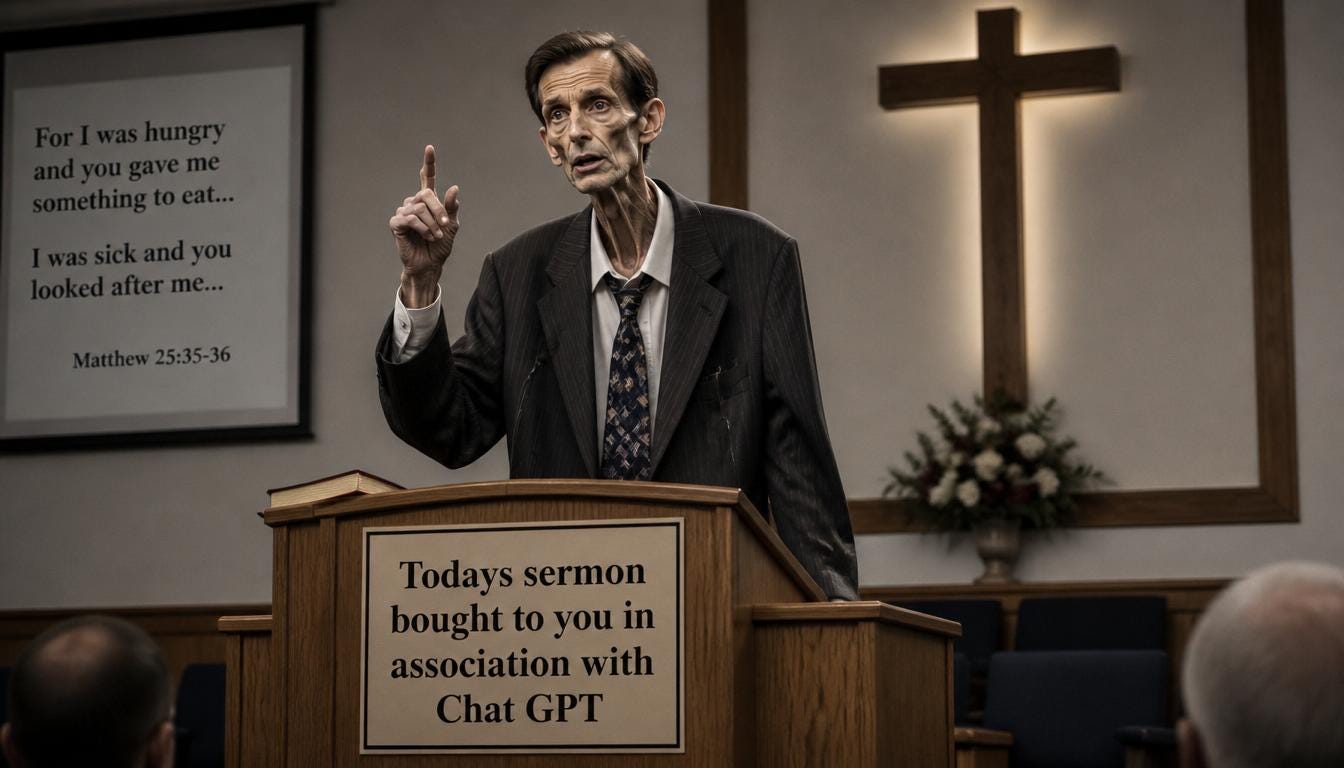
There is a further cost, harder to quantify and more serious in its consequences. The minister who has bypassed the wrestling cannot help the congregation to wrestle. He can give conclusions but cannot offer companionship in the difficulty. He can supply answers but carries none of the pastoral wisdom that comes from knowing how hard the passage actually is, what it costs to submit to it, and what it feels like to hold it when life has become very hard indeed. That wisdom comes from having been there oneself. There is no other route to it.
Three Capacities Being Quietly Eroded
The first is biblical instinct. The minister who reads widely, slowly and personally across the whole of scripture develops a trained perception of how the canon coheres, how themes develop across centuries of text, how Psalm 34 throws unexpected light on 1 Peter. This is not a library of retrievable facts. It is a formed perception, built through years of personal encounter with the whole text. AI tools can identify connections on demand. They cannot give the minister the living perception that makes those connections breathe in his preaching.
The second is theological tenacity. Hard texts require the willingness to stay with difficulty rather than resolve it too quickly. The minister who is accustomed to receiving swift answers loses the tolerance for ambiguity that serious biblical theology demands. He stops pressing the hard question because a soft answer is always available. His theology becomes thinner and more predictable across the years, because he has stopped staying long enough with the texts that would have complicated and deepened it.
The third is personal integration. The word forms the minister’s character, his prayers, his pastoral instincts, his sense of the weight of human life before God. This formation happens through bringing oneself to the text, one’s own confusion, grief, gratitude, need, rather than merely one’s professional exegetical questions. There is no shortcut to that kind of integration. It requires the minister’s whole person, present and attentive, over a long time.
The Gymnasium, the Changing Room, and The Matrix
The Matrix offers a sharp image of what cognitive offloading promises. Sit in the chair, plug in, and in seconds acquire what took others years of hard labour. “I know Ju Jitsu.” You have the information. You have been changed by nothing. Your skill is borrowed, your formation a performance, and the moment the plug comes out you have nothing that is genuinely yours.
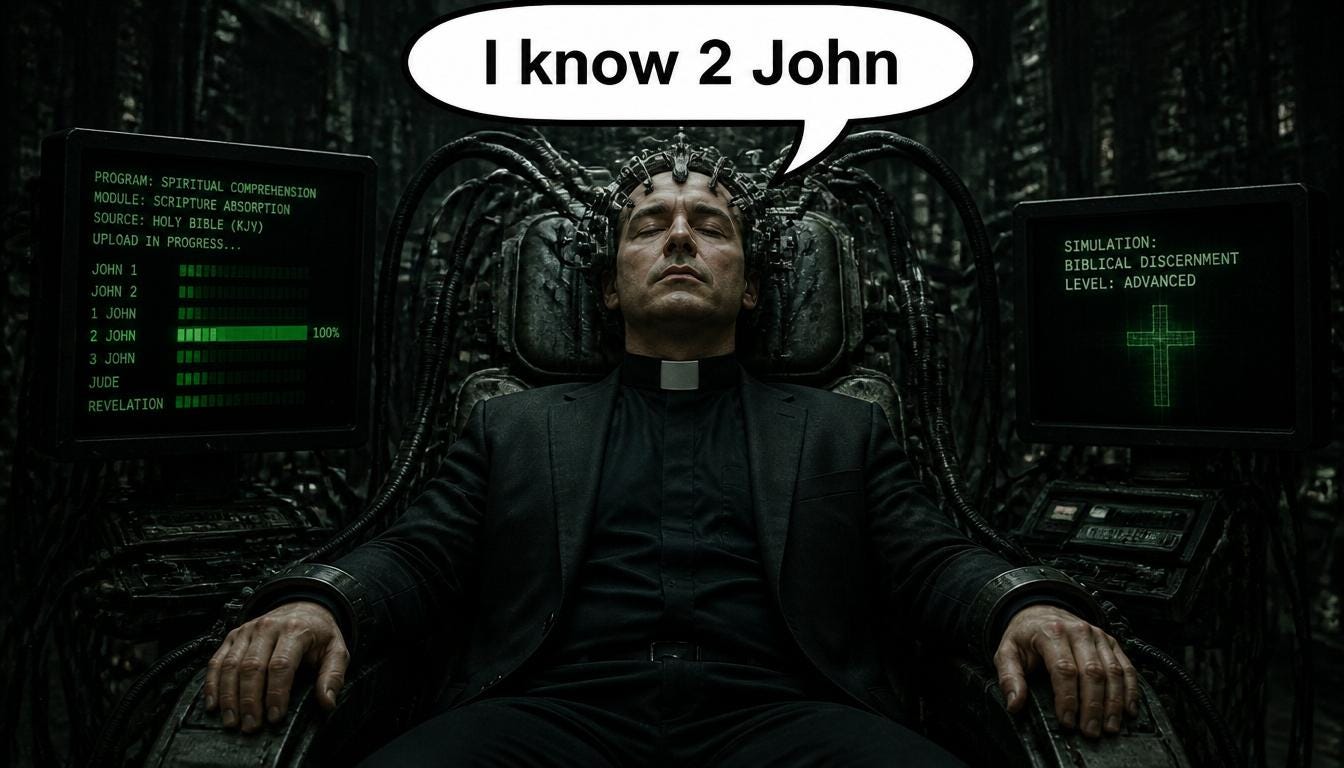
The Lord’s way is slower. It is harder and more dignified, and it treats the minister as an agent rather than a recipient. It honours the struggle as part of the gift. The gymnasium is the blessing, working itself out over time in a person who is becoming capable of things they could not do before. Thirty minutes of genuine wrestling with a passage may well be the thirty minutes in which the Lord is doing something irreplaceable in his minister. Those minutes have a cost. They also have a yield that no shortcut ever reaches.
A Constructive Word to Close
AI tools are not simply forbidden to the pastor who takes formation seriously. That conclusion would be an overreaction, and it is not where this argument leads. Also it would be a cultural misstep to conclude that AI isn’t here to stay. The progress in these Large Language Models is beyond our wildest dreams. Three years ago we were scratching our heads at why every hand had so many fingers and so many unnatural angles. Now we are producing 4K smooth video that is becoming harder to distinguish from reality.
The meaningful distinction is the stage at which the tool is reached for. Use AI to check a textual observation you have already made yourself, to survey what commentators have said on a question you have already worked through, to locate a reference you already know exists, and you are using a reference tool appropriately. Use it to do the primary work of biblical engagement, and you are outsourcing precisely what the Lord is trying to do in you. Use it for the fetching and carrying of known data, don’t use it to generate the data itself. The AI is like the running machine helping you in your own exercise, don’t turn it into a self-running running machine getting on with it by itself and you are just importing the stats to your Apple Watch. Like the man who attaches his Fitbit to his dog to win his family’s step challenge.
The practical principle is straightforward. Do the reading first. Do the struggling first. Bring your confusion and partial understanding to the text before you bring your question to any resource, digital or otherwise. Arrive at your study having already sat with the passage long enough to know what you do not yet understand. Then, if you reach for AI at all, it serves your formation rather than replacing it.
The disciplines that shaped the great preachers of every generation remain entirely available. Extended personal reading. Patient meditation that is content to sit rather than produce. Prayer over the passage before examination of it. Return and return and return to the same text across different seasons and from different places in your own life. These are the gymnasium in which the Lord shapes the pastor who will be ready when the weight is heavy.
The congregations that need faithful pastors are looking for those who carry the weight of the word, who speak with the unmistakeable authority of someone who has genuinely been with Jesus. That formation is available to every minister. It costs nothing but the willingness to sit down with the text, stay with it longer than is comfortable, and let the Lord do what he came to do.
The answer to your passage is the minor thing. You are the major one.
Don’t be a PAiStor

This is a really helpful take. I wonder if another possible reference to the need to wrestle with the word is when Jacob literally wrestled with the Lord. He was permanently wounded but irrevocably renamed and blessed as a result.