


8-15.
VIII to XV.
Here is a number worth sitting with for a moment. After some investigation at Cornhill we estimate that there are somewhere between eight and fifteen men currently in formal training (beyond apprenticeship) for pastoral ministry in conservative evangelical churches across the whole of Scotland. Not eight to fifteen per city. Not eight to fifteen per denomination. Eight to fifteen, full stop, for the entire country.
Read that again. Say it out loud at your elders’ meeting. Watch faces react.
This is not a modest concern tucked away in a committee report. This is the kind of number that should stop us mid sentence and cause the scratching of heads. We are not looking at continued slow decline that future generations will have to manage. We are looking at a supply line that will not sustain current faithful churches, let alone revitalise struggling churches or see new ones planted.
The maths does not work.
Consider what those eight to fifteen men actually need to achieve. They need to replace ministers retiring from existing evangelical congregations across Scotland over the next decade. They need to plant new works in the towns and estates that currently have no faithful gospel witness at all. And, if we are honest about the opportunity in front of us, they need to be ready to walk into the vacuum left by other wings of the Scottish church that are collapsing at a rate none of us would have predicted twenty years ago.
That last point deserves attention, because it changes the whole shape of the crisis.
Take for example, The Church of Scotland, for all its historic strength and its buildings on every high street in the land, it is in freefall. Unclipped from the Biblical Christianity it is on the way to reaching terminal velocity.
Membership fell by well over a third in the last decade alone, dropping to around 245,000 by the end of 2024, itself a fall of more than five per cent in a single year. The number of ministers in post has collapsed from well over 600 a few years ago to under 500 now. Actual numbers are very hard to ascertain but that makes one think it is more alarming than we might think or these numbers wouldn’t be so vague.
Recent reports to the General Assembly have described a “retirement time-bomb,” with the overwhelming majority of serving ministers now over fifty, many over sixty, and some beyond seventy. Presbyteries are merging. Congregations are being told plainly that decline of this kind cannot be managed forever, only endured or reversed. The institution is selling the family silver (in the form of properties to bankroll the losses). One senior figure told commissioners bluntly that ‘without radical change the Church would not survive very long in its current form’.
Whatever you think of the theology coming out of Kirk assemblies, do not misread what this means for us. Hundreds of towns, villages and communities across Scotland are heading towards having no resident minister of any description within a generation. Buildings will close. Congregations will merge, dwindle, or vanish. That is not a moment for evangelical smugness. It is a moment of enormous and sobering opportunity, and we currently have somewhere between eight and fifteen men preparing to meet it.
We are not short of doors opening. We are desperately short of men ready to walk through them.
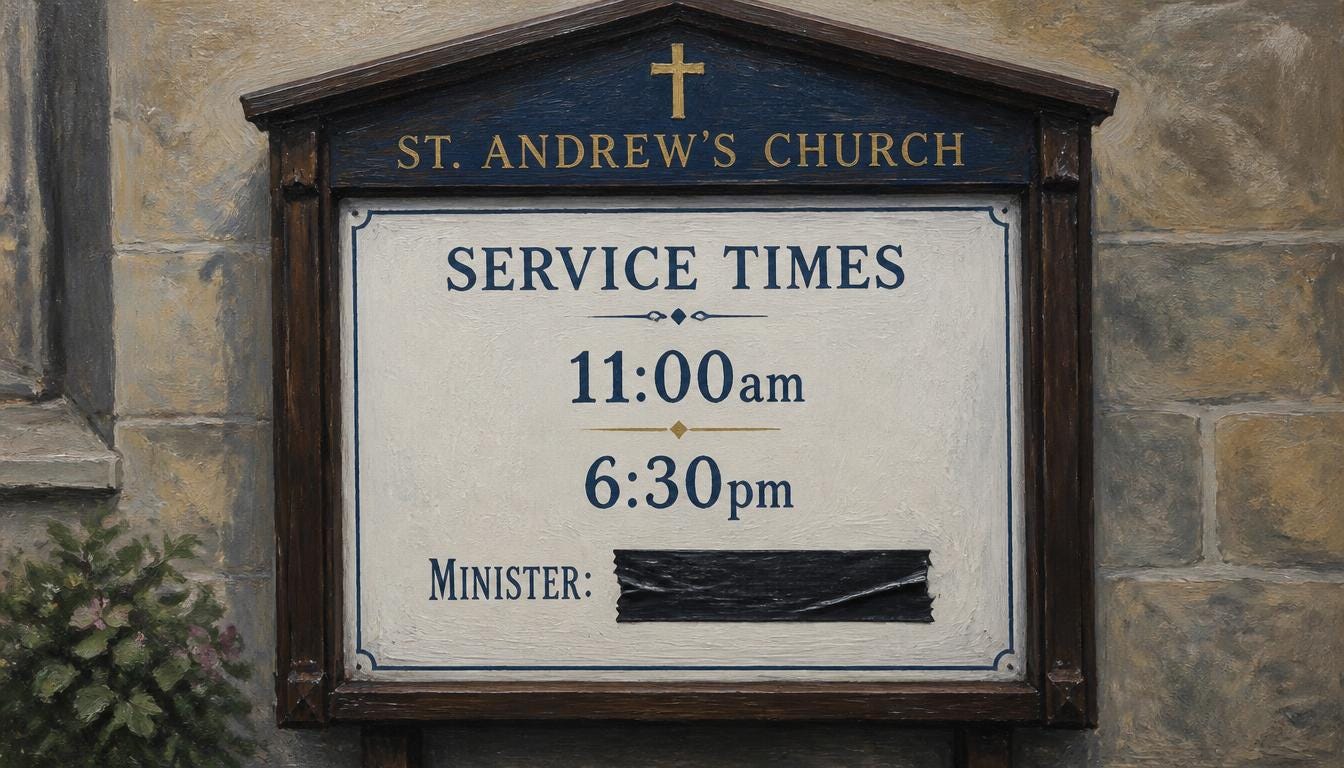
Why has pastoral ministry become such an unattractive proposition?
It is worth pausing to ask why. Not to wallow, but because a problem misdiagnosed will never be solved.
Financial insecurity is part of it, obviously, though it is rarely the whole story.
Stipends have not kept pace with the cost of housing in Scottish cities, and a young man weighing up ministry against a career in engineering or finance is not being fickle when he notices the great chasm in viability. He is doing arithmetic that any of us would do. A pastoral stipend seems to keep the two ends apart with very little chance of them ever meeting.
Status matters more than we like to admit. A generation or two ago, the minister was a recognised figure of standing in his community, whatever people privately thought of his sermons. That social capital has largely evaporated. Ministry now looks, to a bright twenty two year old, like a slightly eccentric choice rather than a respected vocation, and young men are acutely sensitive to how a choice will be read by their peers and parents.
And then there is the job description itself, which has quietly become absurd.
Spend any time reading real pastoral vacancy adverts and you find congregations, entirely sincerely, asking for one man to be orator, chief executive, counsellor, strategist, administrator, teacher, mentor, scholar, social media manager, building project manager, diplomat, crisis responder, and furniture mover, on call for funerals, weddings and every unfolding emergency, for little more than treasure in heaven, which though wonderful is hard to use at the checkout at Aldi.
There is also a genuine and understandable wariness around public Christian leadership in a culture that has grown suspicious of institutions generally and religious authority specifically. Safeguarding failures across multiple denominations, however distant from a man’s own church, cast a long shadow. Stepping into pastoral leadership now can feel less like taking up a calling and more like volunteering to stand in the blast radius of every future scandal, real or imagined. Leadership is now understood as abusive and anarchy as desirable. No wonder we are in such a mess.
Add to this a culture that has trained our young men from birth to maximise optionality. Keep your choices open. Do not close doors early. Ministry, almost uniquely among vocations, asks a man to close doors. It asks for a lifetime commitment maybe to a single congregation, a single town, a single flock, at precisely the age when every cultural signal is telling him to stay flexible.
And then there is the plain absence of visible, joyful models. Many young men in our churches have simply never watched a normal, thriving, happily married pastor go about his work joyfully and sustainably. They have seen harassed individuals standing on a platform, or they have watched a beloved minister burn out under an unsustainable load, or they have seen radically asymmetrically gifted pastors do some things in a way they never could. We have also taught the cruciform shape of ministry in such a way that has given the impression that non-sadomasochists need not apply.
No wonder many have concluded, not unreasonably, that this is not a life they want. That they should just set their ambitions on being a faithful quantity surveyor, civil engineer or chartered accountant to the glory of God.
The folklore of getting a proper job first
There is one piece of received wisdom that deserves its own section, because it has probably done more damage than any of the above put together.
You will have heard it. Perhaps you have said it yourself, with entirely good intentions. Get a proper career established first. Get a trade or a degree behind you. Ministry will always be there. Go and earn a bit of security, build a bit of a CV, and then, once life has settled, think again about the ministry.
It sounds wise. It sounds cautious and pastoral and grown up. It is, in practice, one of the surest ways to ensure a gifted young man never enters pastoral ministry at all.
Here is what actually happens. He takes the job. He does well at it, because the very gifts that would have made him a good pastor, diligence, people skills, a work ethic, make him good at most things. He meets a wife who did not sign up to marry a trainee minister on a low stipend. Children arrive. A mortgage arrives. Comforts accumulate, quietly, the way they always do, until the door that once stood open now requires him to walk backwards through years of accumulated obligation to reach it. Few men make that walk. Most simply stop thinking about it, and tell themselves, and their own sons one day, the same folklore they were told.

I know a few people who have walked backwards down this road, they are marvellous. However, they are but a few. I know many more others who entered the work place with the best intentions and ended up hedged in or journeyed to the far off country altogether.
We must be honest that this advice, however kindly it is meant, most likely functions as a delaying tactic dressed up as wisdom. There may be a handful of men for whom a season of secular work genuinely sharpens their calling. But as a default posture for every promising young man in the congregation, it is not prudence. It is maybe part of the answer as to how we have arrived at a training pipeline of eight to fifteen men.
We assumed someone else was handling this
The second piece of folklore is quieter, and in some ways more dangerous, because it does not even announce itself as advice. It is an assumption.
Most churches assume that somewhere, someone else is doing the hard work of identifying and training the next generation of pastors. A parachurch organisation, perhaps. A seminary. Cornhill. Someone. We give thanks that such training exists, we may send a cheque or put a line in the prayer bulletin, and we get on with the ordinary business of the local church, confident that the pipeline is being managed on our behalf. It is not. It cannot be, not by parachurch bodies alone.
Training organisations can shape and sharpen a man once a local church has already identified him, backed him, is praying for him, and has pushed him forward. They cannot manufacture candidates out of nothing. If local churches are not actively watching for gifted young men, naming the potential they see, and actively encouraging and funding a path towards training, then the pipeline runs dry regardless of how excellent the training itself might be.

We are well beyond hand to mouth. We have been living off the training investment of a previous generation of churches who took this work seriously, and that investment is now running out. It is time to stop assuming and start acting, decisively and without further delay, because the size of the gap will not close itself and it will certainly not close by accident.
I asked a church leader how many people they thought were in pastoral training currently in Scotland. Their guess was somewhere between fifty and eighty. When I said we thought it was somewhere between eight to fifteen colour drained from their face and they protested vehemently that that could not be true. I honestly wish it wasn’t.
This is not a crisis to solve once.
Here, though, comes a necessary theological corrective, because it would be easy to hear all of the above and conclude that if we simply worked harder, prayed a bit more fervently for eighteen months, and ran a clever recruitment campaign, we could tick this box and move on.
We cannot. And we were never meant to be able to.
Jesus looked at the crowds, harassed and helpless, and told his disciples plainly that the harvest is plentiful but the labourers are few. He did not follow that observation with a five year strategic plan. He told them to pray. Ask the Lord of the harvest to send out labourers into his harvest. That is the permanent, God ordained shape of gospel ministry in every generation, in every place, until Christ returns. Demand will always outstrip supply. It is not a design flaw in the mission of the church. It is the design.
This should reshape how we feel about our current shortage. It is not primarily an administrative problem to be solved by a better strategy document, though better strategy would help. It is a spiritual condition to be met with sustained, believing, urgent prayer, offered not once but as the constant posture of churches who know their dependence on the Lord of the harvest to raise up the workers we cannot manufacture ourselves. We will never arrive at a comfortable surplus of pastors this side of glory. We are always meant to be on our knees about this.
But prayer that is not matched by action is not the faith of the Bible. The same Christ who told his disciples to pray for labourers then sent them out as the labourers. Prayer and mobilisation belong together. They are not alternatives.
What bold and decisive actually looks like
So what now. Not another report. Not another recruitment conference on the crisis in ministry. Not a gathering of church leaders naming the problem sobering as that would be. Something bolder.
Every elders’ meeting in every conservative evangelical church in Scotland should, within the next twelve months, have a specific conversation with specific names attached. Which young men in this congregation show early signs of gifts in teaching, character, and a hunger for the Word? Have we told them, directly and personally, that we see it? Have we offered to help fund them through Cornhill, rather than waiting for them to work out how to afford it alone? Are we giving opportunity to serve and see, because readiness is mostly forged in the doing?
Ministers themselves must resist the quiet vanity of thinking their own irreplaceability is a virtue. The healthiest thing a pastor can do in the next decade is not preach one more brilliant sermon series. It is deliberately, sacrificially, and repeatedly hand ministry opportunities to younger men, and keep doing it until potential future labourers become prominent and obvious to the church.
And every one of us, in our ordinary daily prayers, needs to stop treating “raise up more labourers” as a line we say and start treating it as a request we actually expect God to answer, through us, starting with the young men already sitting in our own pews this Sunday.
Eight to fifteen men is not a pipeline. It is a warning shot. The fields in Scotland are white for harvest, more so now than at any point in living memory, as whole denominations retreat from the field entirely. The Lord of the harvest is not short of power. The question, uncomfortable as it is, is whether he finds us short of obedience.
Pray. Then go and have the conversation you have been putting off with the young man in your congregation you already know God has been working in. Do it this week.
How are you defining a “conservative evangelical church? And how did you arrive at the number 8-15? What churches were surveyed?